


The seven portraits form the core of this research. Within these designs it becomes visible how identity is interpreted, translated and materialised in clothing. At the same time, these examples show where these translations create tension and invite further investigation. They therefore do not function as confirmation of a working method, but as a valuable investigation that offers insight into the design process.
Christoph
The design for Christoph departs from his introverted and reserved character. Although he has always been an extremely introverted person, in recent years he has been coming more and more out of his shell. This development forms an important undercurrent in the design. His closed silhouette, with a high, enclosing collar, functions as both a physical and visual barrier. The restriction of movement reinforces his controlled bearing, while dark, matte colours support the reticence. A folded-back section of the collar introduces an opening that represents his softer, family-oriented side.
A tension emerges here: the closure is visually strong and directly legible, while the openness depends on nuance or even on an action, the unzipping. There is a chance that a viewer might overlook this softness, read something else into it, or not notice it at all. This raises the question of whether subtlety is sufficient to communicate layering, or whether nuance gets lost more quickly in a public setting. More fundamentally: is a detail that requires explanation or movement to function still a design solution, or rather a reference that is not visible to everyone?

Luc
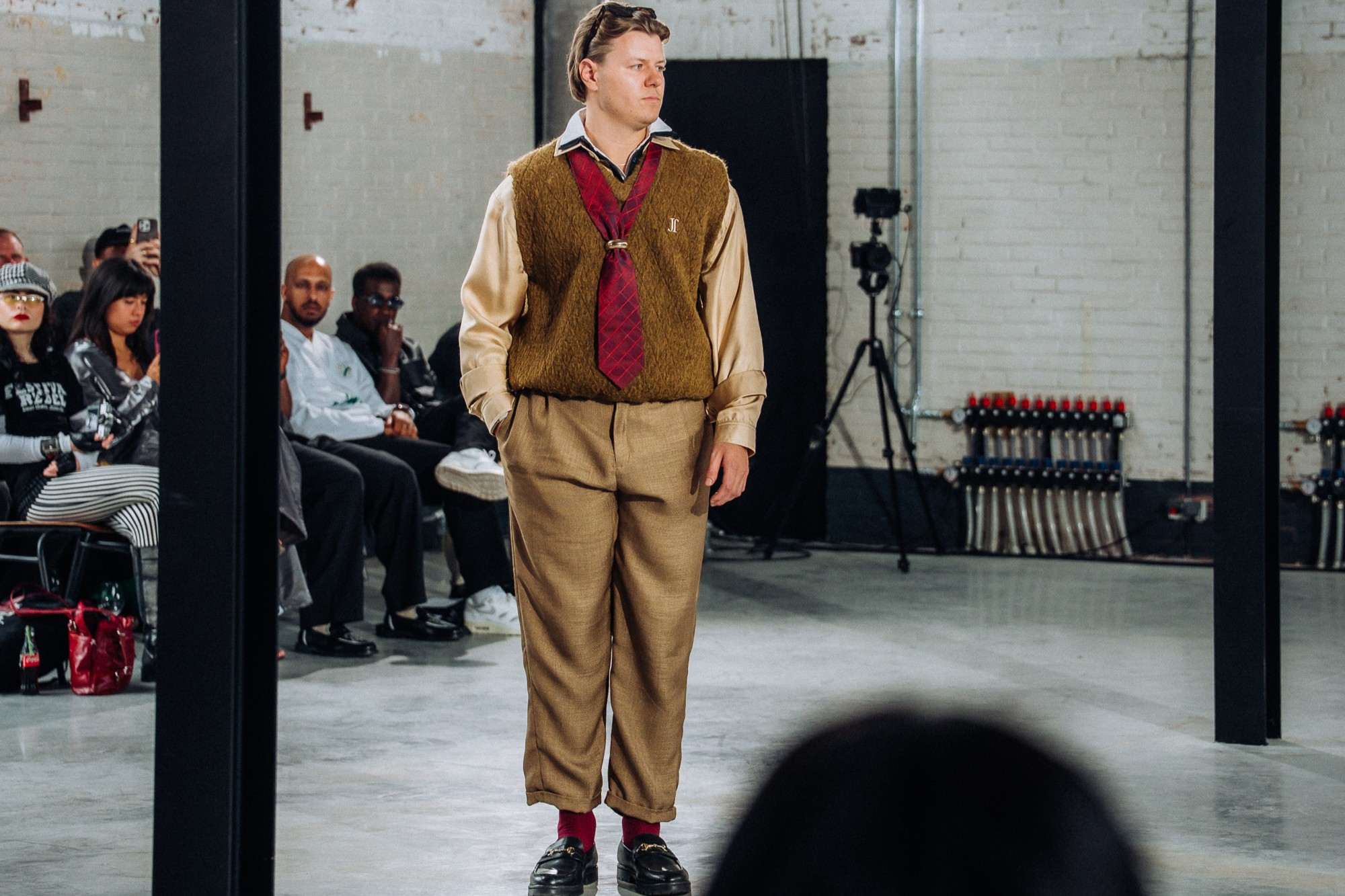
Luc has a controlled, reserved exterior, as though he stepped straight out of a well-heeled Dutch suburb, with a strong creative identity underneath. The trousers are rolled up just slightly too far. The sweater over the shirt features a check pattern as a classic reference, with a small logo detail on the chest reminiscent of brands like Polo Ralph Lauren. Luxurious materials such as satin and wool reinforce a sense of precision; double sleeves refer to his layered nature.
The choice of collar shows how every detail influences the reading of identity: a large fur collar increases presence but can come to dominate, while a satin scarf better matches his understated character but risks going unnoticed. Every decision steers the interpretation of identity. Two additional collar options were chosen: classic, crisp white collar pieces to lift the colour, and a black variant that ties in with the styling of the shoes. A silk pocket square, knotted into a bow, adds a playful pop of colour that is echoed in the socks visible beneath the rolled trouser. The overall look remains classic, but these accents give it a playful twist.
Jelle
Jelle is approached as a stable and consistent presence. Calm, simplicity and contentment are translated into a design focused on weight and groundedness: the silhouette becomes wider and heavier towards the bottom, pleats reference landscapes, a kimono reference introduces balance, and earth tones support the image.
The risk here is that it can become too literal. By translating the symbolism of ‘earth’ and ‘calm’ so directly, the design risks becoming predictable a danger that every portrait-driven design faces when it follows its own logic too rigidly. Its simplicity makes it feel like one of the more coherent designs, but it also shows that I may be on the edge of losing tension.

Olayinka
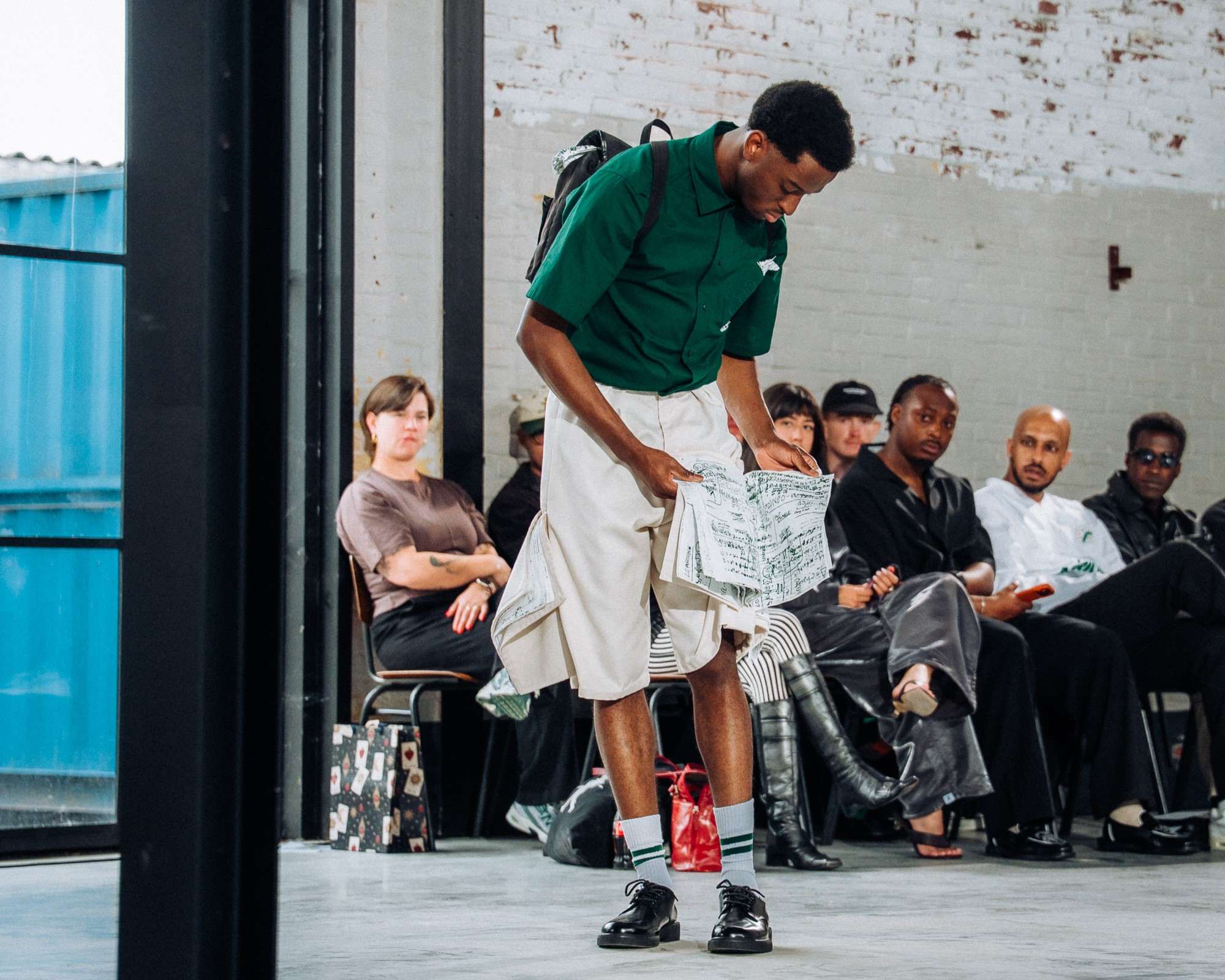
For Olayinka, the focus lies on his inner world, characterised by constant mental activity, analysis and reflection. His background in psychology and neuroscience, combined with ADHD, forms the starting point. The school-uniform-style shorts and shirt reference his academic context, but are disrupted by additions that undermine that structure. A print of overlapping texts visualises the experience of overstimulation; an embroidered brain pocket introduces a more direct, symbolic translation. The combination of abstract print and explicit imagery raises the question of whether this reinforces the identity or fragments it. The design tries to communicate a great deal at once, which in itself can be an honest representation of Olayinka’s inner world, but visually may also come across as ‘a lot’. In this elaboration, the choice was deliberately made to incorporate the chaotic print as annotations in the lining rather than on the outside. An embroidered brain motif has been added to the classic breast pocket. This pocket is placed at a slight angle, with a layered print protruding from it that subtly recurs throughout the piece. This intervention is also carried through in the styling, reinforcing a sense of recognition for the wearer.
This is also one of the cases where the boundary between immersion and over-designing is most sharply felt: the overstimulation exists in the mind of the wearer, but risks landing on the garment in a way that overwhelms the viewer rather than inviting them in.
Brohlin
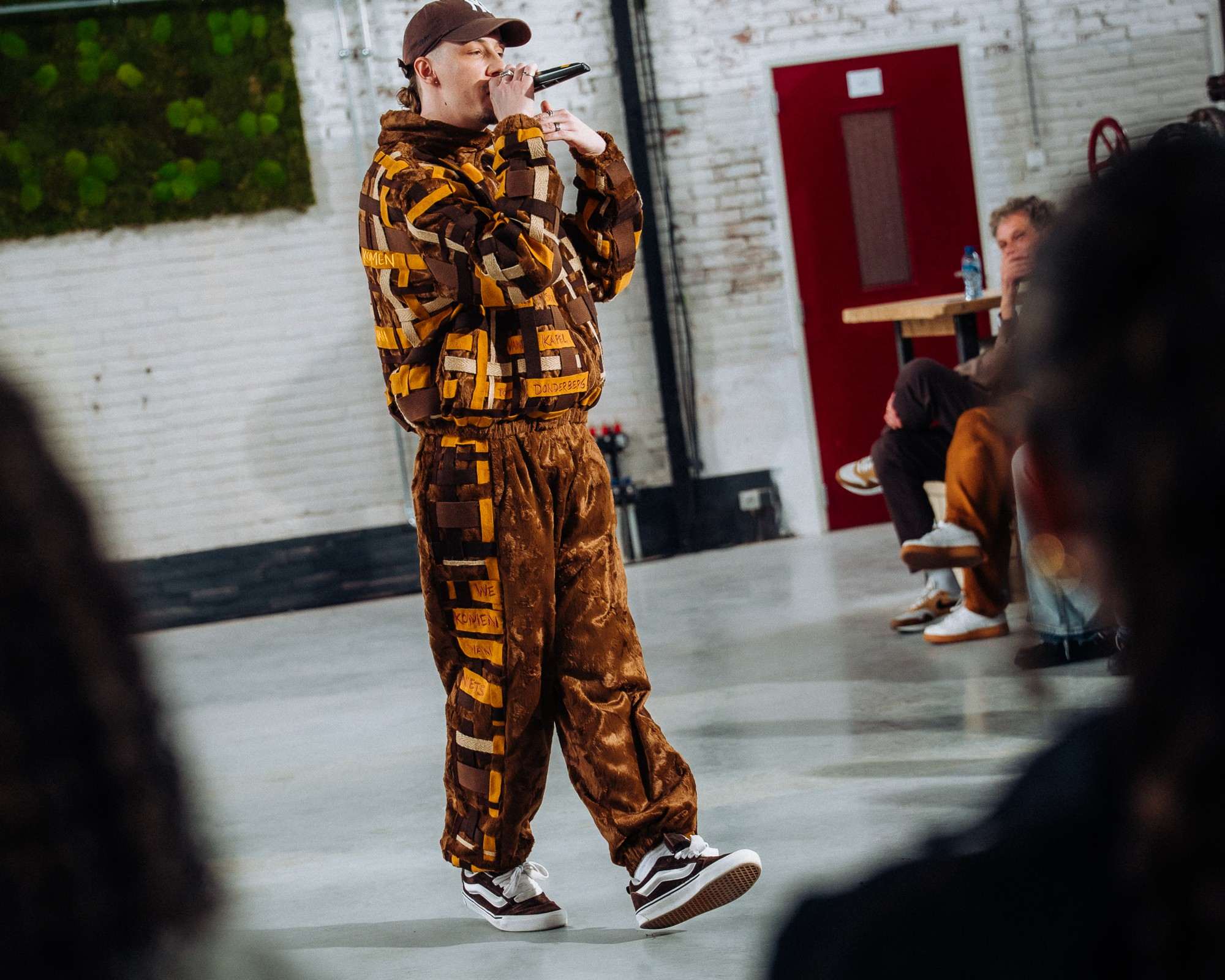
Brohlin is approached as a connector: rapper, youth worker, bridge between worlds. The tracksuit as a base is directly recognisable within street culture. Braid work as a central element embodies connection through the interweaving of materials. Handwritten texts add a personal layer. An interesting tension emerges between collectivity and individuality: the design tries to combine both but raises the question of whether these layers reinforce or compete with one another.
The method of braiding and the combination of fabrics is a decisive factor here. The fabrics and ribbons must be different yet simultaneously form a unity. The same applies to the braiding itself: some sections are more tightly woven, others more open playing with the spaces between them to emphasise the different worlds and their intertwining.
Bryan
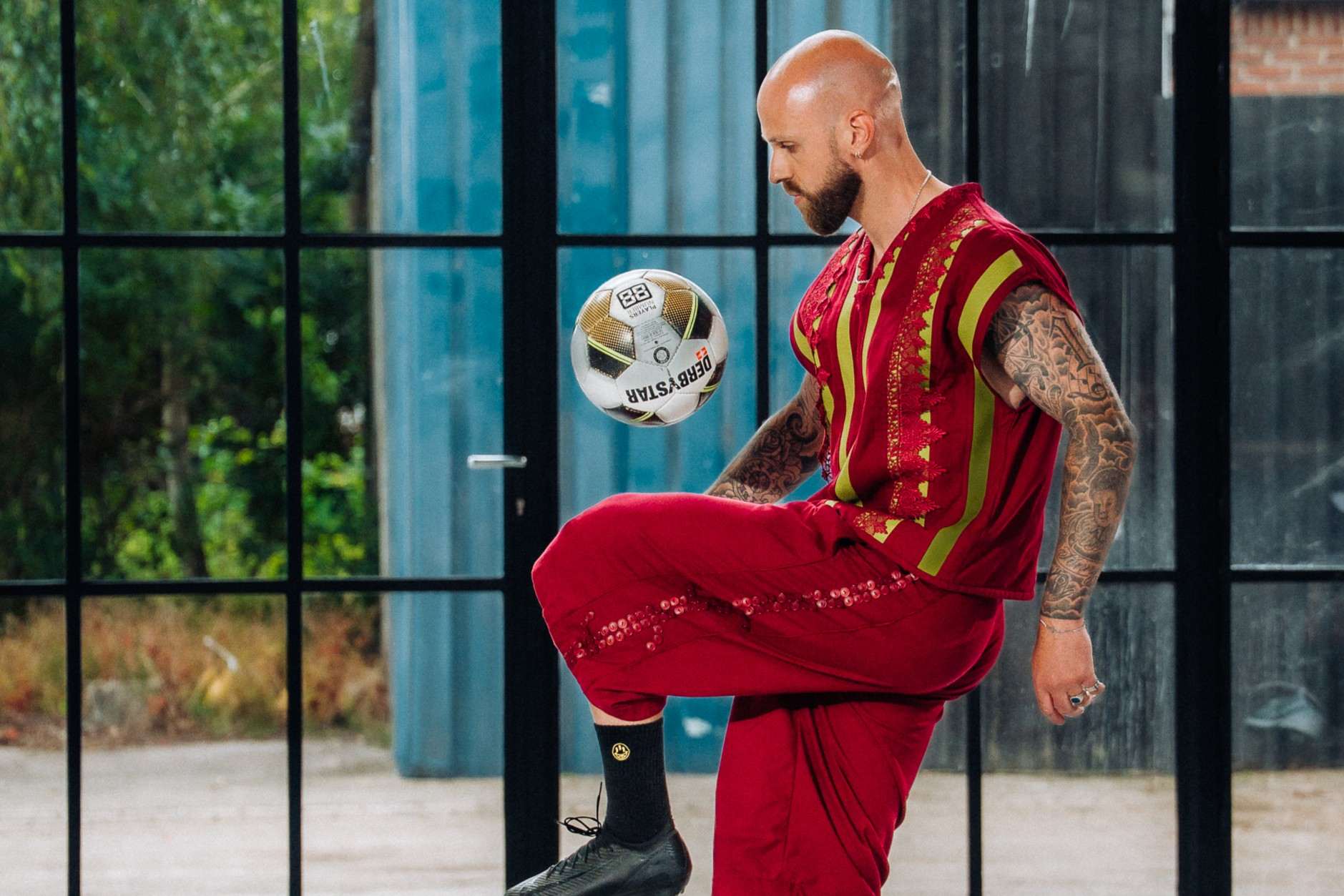
Bryan is characterised by a duality between discipline (professional footballer, structure) and expression (outspoken social personality). The design translates this contrast by allowing both sides to coexist: a hybrid silhouette combines sportswear with tailoring elements. I deliberately chose a colour combination that is not standard. Precisely because this combination deviates from the expected, I notice in practice that it provokes different reactions. These varying interpretations are therefore not accidental. The contrasting colours reinforce this tension and represent his two identities without fully merging them. The reference to Johan Cruyff’s squad number adds an extra layer, but also exposes a problem: the meaning is lost for anyone who does not recognise the reference. The design is therefore partly dependent on shared knowledge that is not universal.
Gidion
For Gidion, the choice was made to base the entire coat on the neighbourhood of Kura Hulanda before its restoration; a neglected environment carrying deep underlying pain that Gidion actively fights for. Hence the symbolic look of a boxer: boxing shorts and a long coat. Gidion must radiate strength; someone unafraid to be present and to speak out. Gidion may represent the most complex portrait: his personal identity and cultural history come together. The reference to Kura Hulanda introduces a historically charged context. A contrast in the design and a raw finish visualise the tension between restoration and a past that cannot be fully repaired. A patchwork construction based on a historical map makes that history literally visible.
A fundamental question arises here: to what extent does Gidion himself remain visible within this larger story? The design risks overshadowing individual identity with the weight of historical context. When the story becomes larger than the person, is it still a portrait? Or does it, given Gidion’s deep connection to this history, still show enough of him, without the design or my position as designer pushing the interpretation too far unintentionally? This is a tension that cannot be fully resolved in the design itself, and perhaps does not need to be.

Provisional Conclusion
The seven portraits show that no single method exists for translating identity into clothing. This is precisely why the choice was made during the process to embrace this ambiguity and engage with each person at different points. Every attempt brings choices, reductions and interpretations. Designs do not fix identity they question it. It is precisely in the moments where the design falls short that the research becomes most interesting: that is where the limits of clothing as a medium for identity representation are most sharply visible.
What the seven examples also collectively reveal is a difference between designs that operate from a clear visual logic, such as Jelle’s, where the visual language directly connects to a palpable personality, and designs that depend on story and context to be read, such as those for Gidion and Olayinka. The balance between the autonomy of the image and the reliance on explanation is a recurring question in this research. A design that only works with elaboration does not communicate enough on its own. But a design so directly readable that explanation becomes unnecessary risks losing its depth. That balance, and whether it is achievable, remains an open question after this research. It forms a foundation that I can develop further and put to use in my career and future design practice after the academy.
Next page is Discussion or go back to Presentation.